
“HAIL AND WELL MET CITIZENS!”
– Your Friendly Neighborhood Tin’kan
In a world full of TTRPG opinions, “hot” takes, and overly wordy articles looking to hit that sweet, sweet, word count I invite you in today to indulge in a treat.
A short review article that just might be longer than it’s subject!

My TLDR:
Baldur’s Gate Upper City Intrigue was honestly, truly, no lie, a pleasant surprise. The reality of what Wonderstone Workshop put together took me a little while to properly appreciate. I had to sit with it until it clicked – if a DM is like a chef putting together all the ingredients of a campaign to create a feast for their players… then Baldur’s Gate Upper City Intrigue is a bouillon cube for a hearty soup. A quick, condensed, pop of flavor that gives you a base to work from; to add depth and personalization to.
But not a meal on its own, which could get a novice in a little trouble.
What is BG Upper City Intrigue?
- Compact
- Flavorful
- Roleplay forward, focused on intrigue
- Not intended to be combat-centric
- Five one-shots with the option to interconnect
In the creator’s own words, the pdf is “Five Short, Sharp Adventures Beyond the Old Wall” and it absolutely lives up to that blurb. Set after the events of Baldur’s Gate 3, it’s 4 pages for 5 well written, condensed, adventure outlines. There’s a couple cute art pieces as well as a cover and back page that pad the pdf out to 6 pages, but that’s the trick – there’s no fat on this. I want to see Ross Wade’s cutting room floor, because pretty much every word carries weight. These are meant as one shots to pull out of your back pocket, but with plenty of flavor. There are no maps, no extraneous NPC blocks, no magic item blocks, no box text — it’s all business — and that’s not really a bad thing. It’s a series of improv settings and mini games that could easily spin a table into hours of play for each entry, with each successive scene longer than the prior as levels increase.
Let’s break this down into The Good, The Bad, and The Rest.
The Good
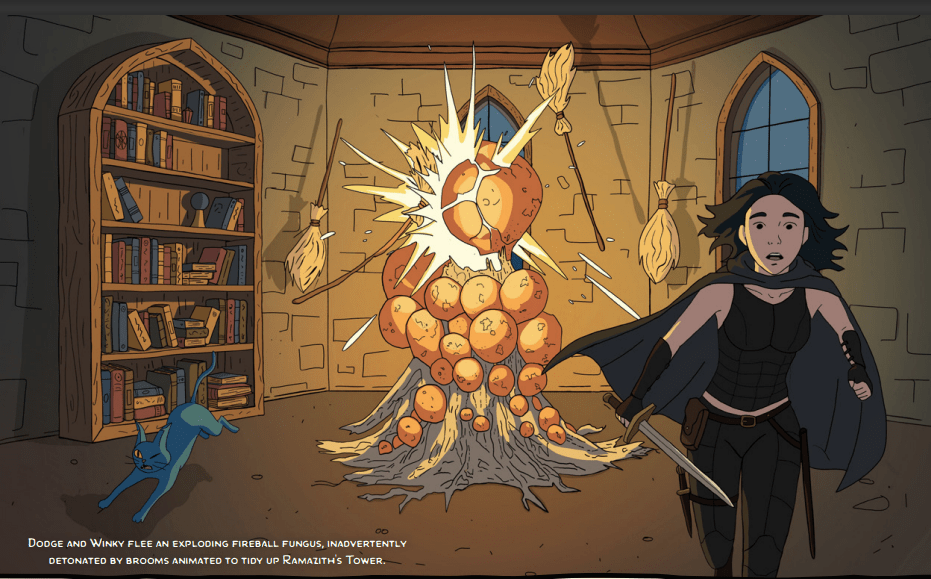
I cannot stress how much weight is in this tiny supplement. It’s just 5 little story hooks. Five quick adventure ideas with a setup, NPC motivations, potential obstacles – escalations, conflicts, twists, and rewards… in a few paragraphs. Each one a complete soup starter to get you halfway to finished once you start filling in the gaps. I really like how the lack of extreme detail gives you plenty of room to move as a DM, but enough structure to keep things focused.
They use a handful of solid tricks to keep things slim, too, like not including maps – but pointing you to maps in the DMG! Something you should already have access to and probably never use, if we’re being honest with ourselves; right? Every NPC is from the Monster Manual, some have a minor tweak or change; but minimal and succinct in their description. Then there are the, I hesitate to actually label them “minigames”, but each adventure frames itself around a fun/interesting mechanic that leverages existing game rules (mounted combat for jousting, renown for a fancy party, dnd’s social mechanics for dealing with hostile/neutral/friendly people amidst politicking).
It’s not mind blowing content, it’s just very well put together.
The Bad
I think there are missed opportunities. Minor things, but things that could have given the product a little more heft. A tiny bit of an edge to fight the human instinct to balk at spending money.
Things like an appendix of seperate tables to roll for spell effects and monsters to re-theme or create a different list of Encounters for the level 6 adventure. Or to “reprint” the magic items, specifically, as cards (since this is on DMs Guild) at the end of the document. Even if there isn’t art, NPC blocks could be added as quick references instead of needing to keep the entries bookmarked at the table. Minor quibbles.
Beyond even that, though, I would have really appreciated was a small timeline. A brief overview of the nobles and current happenings in the city. It doesn’t need to be a lexicon or even a deep dive on the lore. Just a few paragraphs of cliff notes to help people better understand what it is they’re dropping their players into; without having to fall down the rabbit holes on the wiki. Things like who the current Council of Four are (depending on how soon this is after BG3/Avernus it’s possible only Ravengard is on the council canonically), a little bit about the Parliament of Peers, how Lady Ravenshade or Sir Thax fit into the larger scheme of things. All easy appendices that could probably double the size of this pdf without increasing the man hours by much.
Lastly, because it is so compact, so condensed, I believe there are sections that would benefit from room to breathe. Hinted at in the notes above, I think trying to keep everything super “toit” has some slightly silly edge cases the DM will have to paper over. The political intrigue at the end probably being the most obvious, despite having the highest wordcount. The twist is kind of crammed in with the rest of the people just hanging out talking shop – I recommend spending some time reworking the third faction if you have the time and experience to do it well.
The Rest
Let’s address the price – $5 after tax, outside of a sale, for 4 pages (6 with front and back covers).
I think it’s worth it if you have the budget. It’s a good, short, piece to read and have in your pocket and a great example of how to make your own notes and quick one-offs. (Not to mention DMs Guild takes, like, half of any listed price.) Considering you could literally get 5 sessions out of this, give or take, I say support the quality writing/ideas.
Which brings me to the last “note”. As a sharp example for newer DMs, it really does nail the premise, showing how to frame hooks and highlighting rules old hats tend to ignore. But it does require knowing how to fill out all the missing “in between”; something veterans should appreciate. Not a huge lift, and really not a “problem”; but, you know, gotta have the disclaimer somewhere.
There are no rails here, but plenty of hooks and room to improvise.
Like any bouillon cube, it’s not the whole meal – but drop it in and the broth of your game instantly gets richer. I truly was not expecting to enjoy this the way that I have, so I say toss a coin to your indie dev today!
*Krusk FYI: The fine folks at Wonderstone Workshop sent us a PDF for this review.
 The TTRPG Factory