
Joe over at Dark World Studios reached out asking about a review of their new game, Acheron and sent me a copy, some great art assets, and a ton of info. He pitched it as “Orwell’s 1984 meets Lovecraft’s Call of Cthulhu“, and managed to hit two of my all time favorite books in one with his pitch. So I figured I had to take a look. The review PDF I got was 593 pages, so this is a fully fledged RPG in the vein of Shadowrun, Vampire The Masquerade, or your other big single volume RPGs. So I took a little over a month and dug in. Made a few PCs, sandboxed a few encounters, scenes, and even had some friends tell me what drew them in vs what didn’t. While I haven’t run a full 12 month campaign or anything, I did get to play with the rules, and get under the hood. What I’m getting at, is this is a bigger meatier RPG than some of the other TTRPGs, I talk about and so I spent more time on it.
The pitch for an Acheron game is that you’re a senior government agent working to cover up, or otherwise address the supernatural. A sort of Art-Deco Hellboy, Men In Black, X-Files set up. I’m really into this genre right now, and have been looking for a good game that really ticks all the boxes. So I was pretty excited.
I'll put a TLDR at the front of this one. Acheron wasn't for me. That doesn't mean its bad, but it didn't hook me. When that happens, I'll check with some of the other authors and usually one of them is into it, so they write the review. Very rarely they also pass. Thats happened once or twi ce now, and when it's an indie dev, I'll usually bow out of the review. I'm not super interested in a tear down of a small business. If Its WoTC, Paizo, or a big name? Ill go at it, but smaller folks, I don't feel compelled to bring them down. Thats journalistic integrity for you. Or I dunno what it is, I'm not a journalist. Either way, I checked in with Joe, and he said that he wants it posted regardless. Props to him, and I've got to respect it. Acheron is d20 based game, so a lot of the mechanics are familiar. You have 6 ability scores, you can allocate points, roll 4d6, or use an array, and your 6 stats are the ones you expect. This makes the game very easy for players or groups that have only used D&D before. If you’re old like me, think D20 Modern + Urban arcane slapped onto a homebrew setting. I know, I probably lost some of you there, and you might be able to make up your mind with that alone. Especially when I point out that its basically the same pros and same cons, as the other one. Written in 2002. Or the probably hundreds of comparable games. I think this is probably my biggest gripe overall. Instead of writing a game to tell the stories, Acheron is mostly reskinned 5e. While 5e does some things well enough (5v5 tactical skirmishes) theres a lot it doesn’t do well. Notably, intrigue games and modern games.
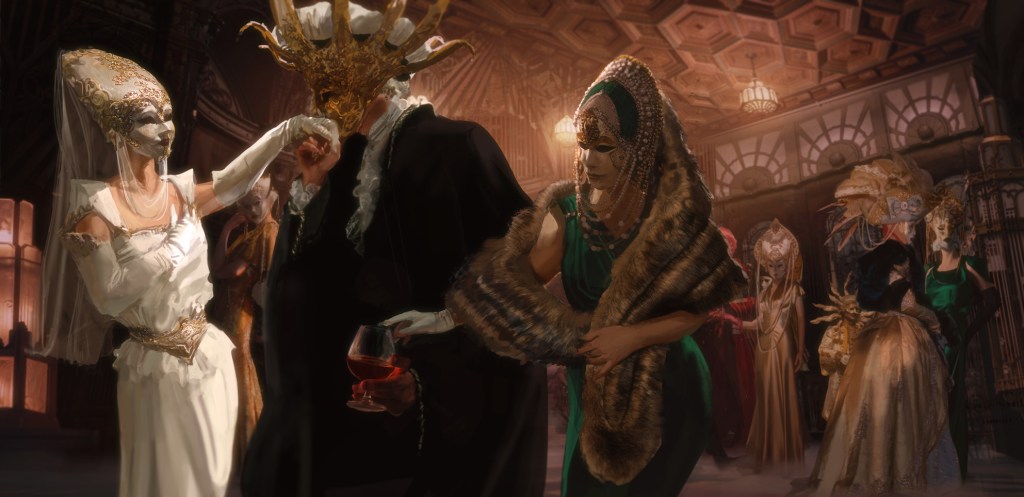
Acheron has what I’d classify as three main mechanics. And then, a lot of fluff, or one or two page subsystems. The three big areas that matter are Race, Abilities, and The Occult. So I’m going to spend most of the review talking about those, and I’ll summarize the rest at the end.
The best thing Acheron has going for it are their races and subraces. There are 3 races, Human, Darkleechers and Soulmenders, and each race has a collection of subraces, or Pedigrees, to distinguish them. This is nice, so you can have a setting with like mostly humanoid things, and not 4,000 playable races. It makes the lore a lot easier to pin down, and keep consistent (In D&D how many times do they mention long lived dwarves 5-6 pages away from elves who livee 5x as long and dragons living 100x as long?). Each Pedigree gives you ability score caps, hit points, move speed, and Merits and Flaws. As you level up, you can grab merits or pay off flaws. Its a nice way to make race matter past level 1, and its pretty cool. This is probably the best part of Acheron, and each race seems genuinely interesting, and mechanically, I feel like its going to come up most sessions.
- Humans Pedigrees are
- Human: Default, and sort of looked down upon for not being as cool as some of the more fantastic races. That said, its positioned as an overlooked underdog, which can be fun. Its Bruce Willis in Die Hard.
- War Born: In bygone days your ancestors were bred for war. Thats not the case now, and they sort of drift around looking for purpose working as laborers, tradesman, or mercenaries. Generally drawn with a neat viking spin, and not a dirty, covered in rags ascetic that you might think.
- Grey Blood: A clan with a drive for knowledge and science, that sometimes goes a bit too far. Its got a lot of blue blood metaphors, and that can be a bit fun.
- Ellison House: An ancient family of bankers, jewlers, and cosmietic(-ers?). This is a rich people family, and they act like it. They are stuck up, better than you, and they aren’t afraid to remind you. Although theres certainly room for some fun collaborative PCs with that mentality. The rich kid who rejects their family traditions, unknowingly naive rich kid, adopted rich kid, 2nd son who won’t inherit anything, or popous jerk (played for laughs).
- Gripes of the Church: Religious witch hunters, which isn’t as much of a crazy person as most witch hunters. Considering the game’s about hunting witches. This ties into the lore a lot more than the others, which is solid.
- Exalted: Humans who live in the mutative region of the world, known as “The Wall”. They banish the untreatibly sick, or the outcasts to live here where they get mutated into monster people. The art has 3 arms which is immediately attractive to me. They have all sorts of sweet monster mutations, like Earless, or weird ghost wings and a stinger.
- Darkleechers appeared in Acheron after The Breach, where hundreds of thousands just washed up on shore. People had no idea what to do with them, and a race war broke out. Thats settled down, and now they are pointy eared, bright colored skin, alien guys that look kind of like elves or tieflings. Their pedigrees are
- Fae: Fey Darkleechers, with some trickery and luck themed powers. One lets you force a missed attack to be a crit failure, which is an addition to the game. The combat chapter talks about how they exist, and references a table, but I couldn’t find it. I assume you’re supposed to use whatever homebrew crit failure mechanics you normally use. And also, don’t.
- Spirit: Animal themed Darkleechers, with things like antlers, bark for skin, and pearly eyes. They get natural animal or maybe plant based powers which is pretty fun.
- Demonic: Large, red skin, horns, you probably get it. They’re even said to often be lawyers. One merit that jumped out at me was the Ichor blood, where your blood is poisonous. The most active use of this merit, lets beasts know so that you can reroll an animal handling check. I see that coming up a decent ammount, but to me the fun part is that anyone who drinks your blood is magically poisoned. I see myself doing something fun with that in game a lot.
- Eldritch: These are “spooky” or “otherworldly”. They have weird traits, like unearthly pale skin, accuenated with blues and greens, and potentially gills or tentacles.
- Soulmenders were humans or darkleechers, but when they were slain their soul got trapped in a soulmetal phylactery. So now they are warforged, robot people who used to, but no longer have their own body.
- Half-Leechers are a group of half darkleecher half humans. Its super rare, but lets you play out the child of two worlds fantasy.
Where Acheron differs from its classic D20 roots is the use of Abilities. Acheron is a classless rpg, and instead of spending XP to take levels in sorcerer, which give you spells, you gain CP which you spend directly on powers. The powers are kind of like feats, or class features, and they unlock new stuff. They are arranged on a page with a pathing tree, reminding me a lot of Fantasy Flights games, Some are very straight forward with a clear path, and others are fairly extensive. There are a boat load of these, and you can really have a good time mixing and matching various builds. As an aside, Abilities is a pretty bad name for these things, because Abilities is such a commonly used word when talking about RPGs.
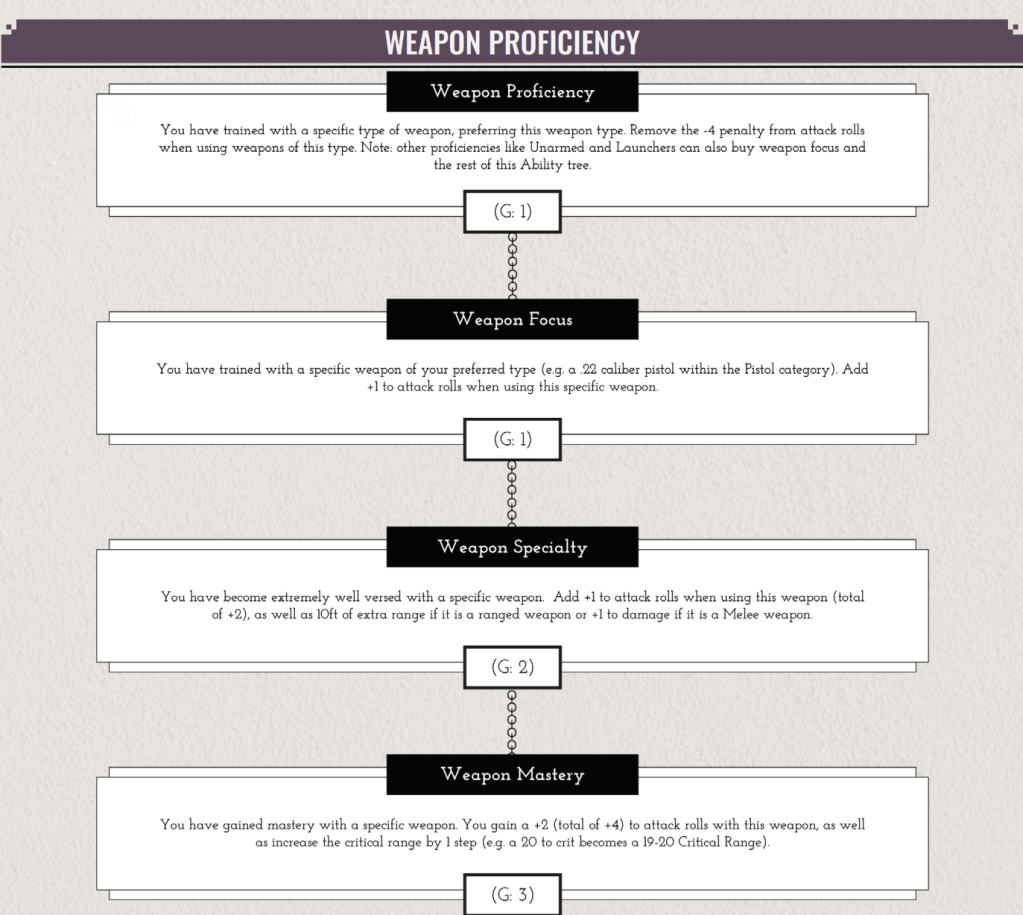
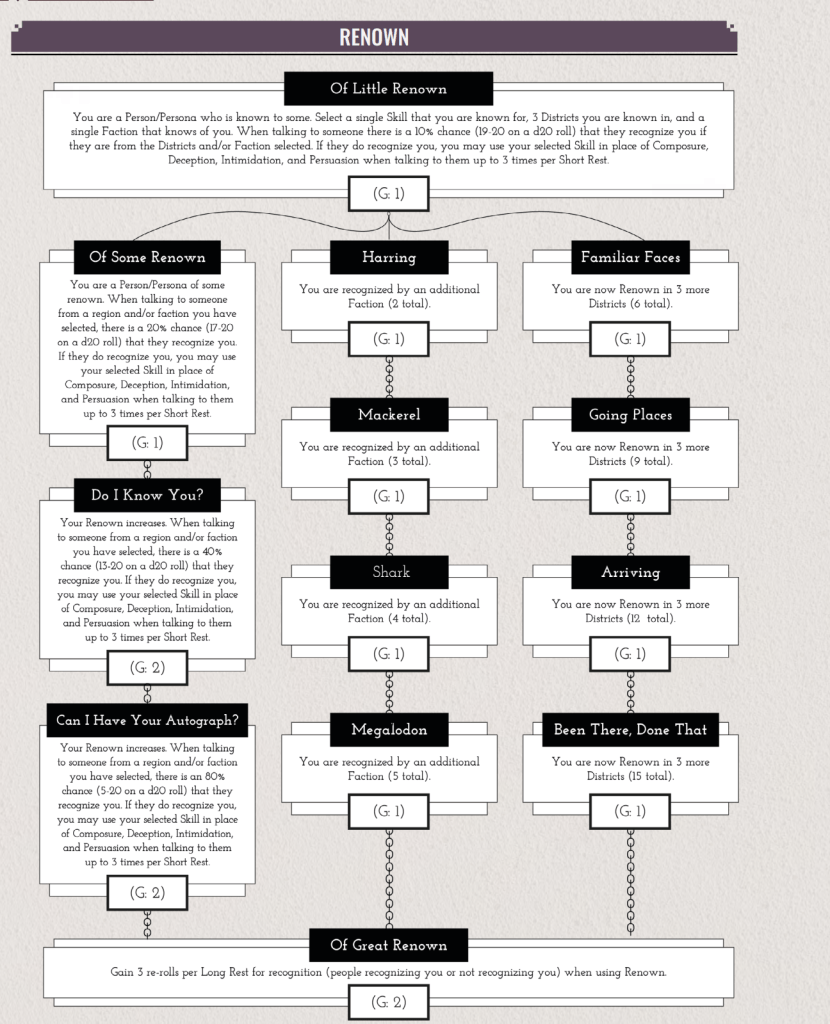
The fantasy flight feat paths are neat, and visually interesting, but they also get a bit restrictive, and kind fiddly. That weapon mastery ability for example, for a game like this, that could be a first level ability. But because its a tree, you’ve got to really invest heavy in it to get pay off. And the game has to be designed for someone who beelines hardcore for weapon mastery asap, and for someone who takes it as their last ability of the campaign. So its also accidentially lowering the overall power level of the game and keeping it super tightly bound. Conceptually, that makes sense for the style of game we are looking for here, but man, trying to play low powered, gritty 5e just sounds brutal.
So we’ve talked about the idea that you’re a Man in Black hunting down the occult in a fantasy art deco setting, and you can take merits to give you powers, but the big thing left unsaid is how you go do it. Its not just “I have weapon mastery on swords”, although I guess you could. In practice, you’re probably going to want to grab one of the 5 Occult Practices or the 8 Mancies (Which are almost indistinguisable from Practices, but probably important from a lore perspective). Each has a little bit of a different mechanic for how you cast spells, which spells you cast, and how they recover, but they generally unlock 3-5 spells per tier, with 5 tiers per Practice. Thats about ~120 spells for Practices, which is actually quite a bit.
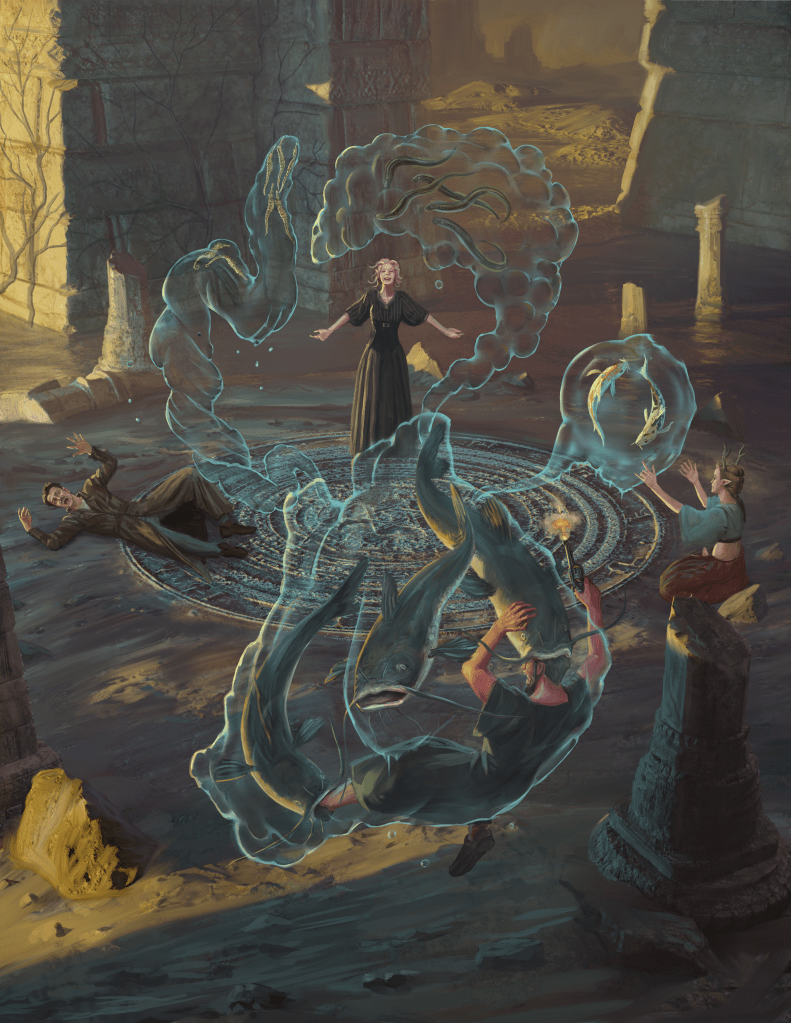
- Arcane: Arcane spells work like classic fantasy spellcasting. You get a mana pool and can spend mana to cast spells. There is a cool bit where they recharge mana per hour of meditation on ley-lines, which is a nice bit of lore, but I wonder if the DM or player is expected to constantly track how close the character is to a leyline so they know if and how much mana they recover.
- Fey: Spells have a luck theme, and the if you cast them you start to accrue stacks of Luck or Unluck. You can do stuff to balance the two out, but its a fun game you get to play trying to balance your luck and unluck.
- Spirit: Spells have you pick an aspect each morning. Each aspect determines your spells and rituals for the day and how they work.
- Demonic: Spells are hit point casting. Most demonic spells let you spend HP for a kicker effect, and I like that if you actually kill a target, you don’t have to pay it and instead heal. It’s the sort of thing that encourages the player to take risks, and thats always good.
- Eldritch: Lastly, Eldritch spells have you balancing a sanity score. As you cast spells, you might take sanity damage. Similar to the Demonic spells above, but with a different pool.
In addition to the Occult Practices, you can also be a Mancer. Mancers get a couple of abilities related to their theme, that are mostly weird powers you can just do, not spells. For example, a pyromancer might have the level 2 power “Heat sense” where they can detect objects giving off heat signatures. We get a good variety of options here, and you can be a pryomancer, cryomancer, telekinesis, magnetism, biomancer, necromancer, neuromancer, and auramancer. Each pairing does have an opposition though, so while you can be a pyromancer and a necromancer, you can’t be a pyromancer and a cryomancer.
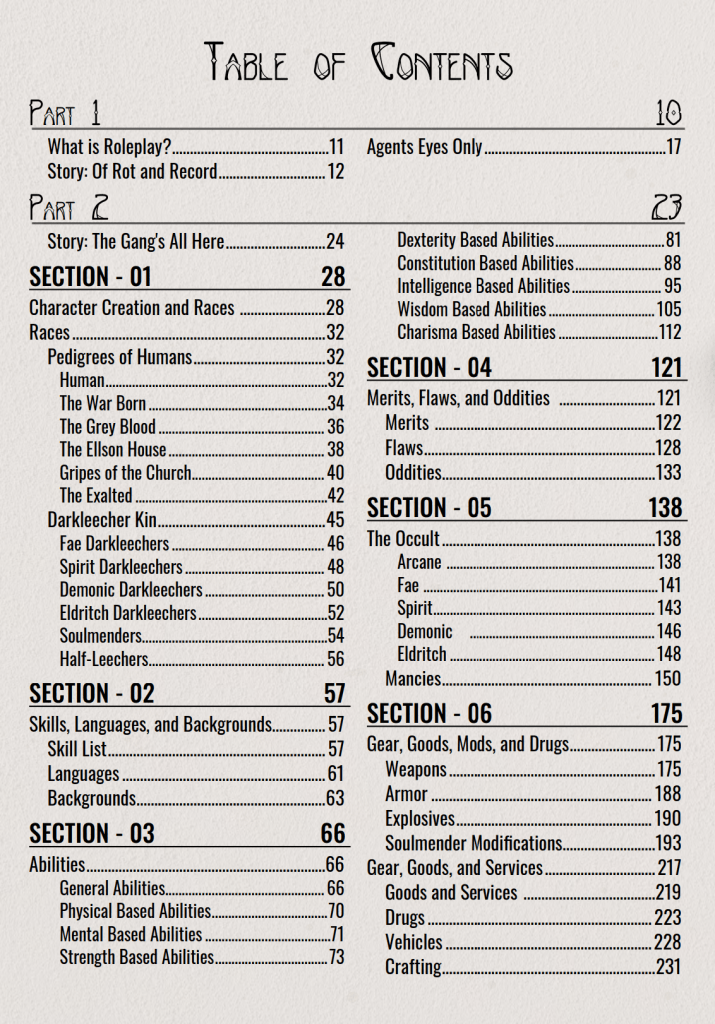
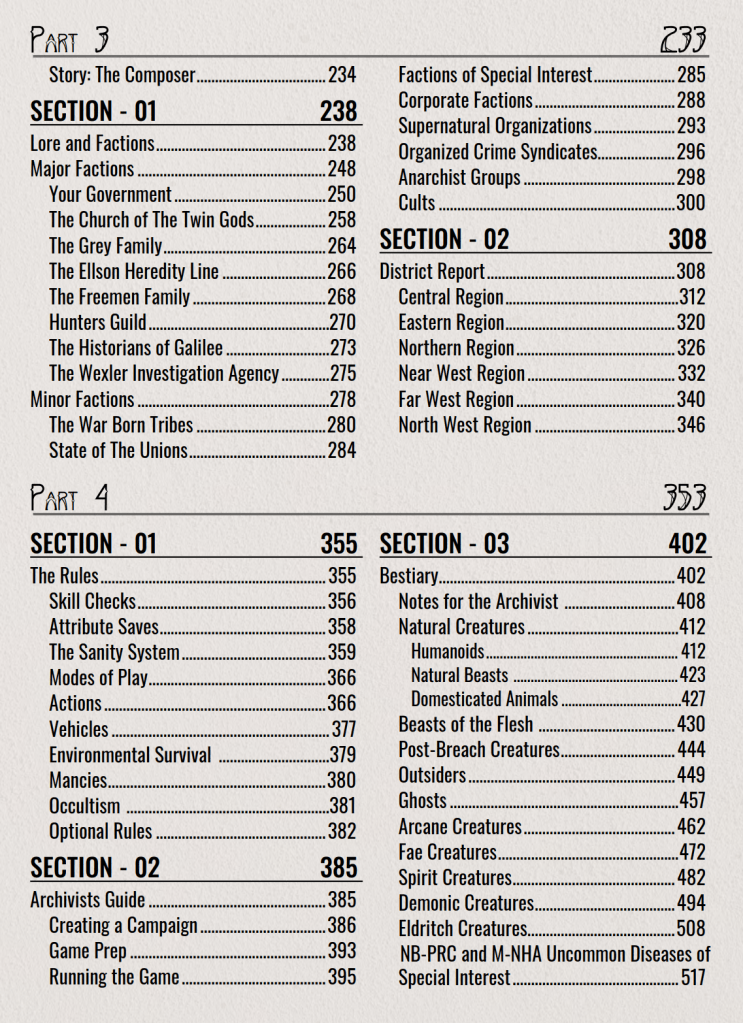
There’s potentially a better distinguishing factor between the two, but it was not super clear to me. Which kind of leads me to a tangent I’ve been avoiding. The layout of the book, and table of contents. It needs a lot of help. Someone clearly put time into it, and its got a neat art-deco 1984 spin to it that makes it feel classy and classified. But its not usable. I spent hours trying to figure out how to learn a Practice or Mancy, and I’m pretty sure its not described until an appendix. Because its forbidden, and they are in lore discouraged, so they should be rare. But in practice, its the coolest part of the game, and PCs are already rare. As for the table of contents at the front, its not labeled and done in a two column format where each part is its own table. I’ve done this in word, and its annoying when you do it by accident. But it makes the whole thing hard to use. And none of the parts or sections have labels. So you’ve got to kind of guess what each chapter is about and what’s included. I was wrong a lot.

As for the actual rules of the game, we are presented with a hybrid of 3 and 5e D&D (we brought back move secondary actions). Its the authors preference for best in breed for both games, and probably runs about as well as any game where the DM asks you to add in 30-40 house rules. Well enough. All the players but 1, just use their system of choice (3e, 5e, whatever) for most things, and it doesn’t matter, but sometimes theres some confusion where the DM reminds everyone its not 5e or 3e, and then breaks out the rules. IMO its a big problem with house rules in general, and why I recommend no more than a single page for 3e or 5e, while simultaneously writing my own entire system repalcement and acknowledging that there are probably 100+ pages of house rules that would improve 3e and 5e. Yeah, the house rules are probably better. But not at the expense of annoying the players, or the confusion they cause.
I’m skimming through a lot the actual rules, because, well, its mostly just 3e or 5e reskinned. Theres a sanity system, and it works like you would guess if you’ve seen a 3e or 5e sanity system. Its got skills, and for the most part its the 5e skills with some older 3e skills added, and some modern skills swapped in for fantasy ones. It has vehicle rules, but they are about as in depth as 5es. Its 2 pages, one of which has a chart, and the other is a half page.
Factions are an important part of an intrigue based campaign, and Acheron has loads of lore about them for the DM. But I couldn’t find any mechanics, so its kind of just left to whatever your DM thinks sounds fun. I have no game based incentive to build faction rep, or fight against a faction, or care if a faction doesn’t like me. No incentive to interact with the game. That sort of thing is great to include, in a splat book fleshing out the factions of the world. Factions of Acheron, a dozen major and 20 minor factions to flesh out your Acheron games. After the main book has 3-4 major and 5-6 minor ones, with actual rules for us to use.
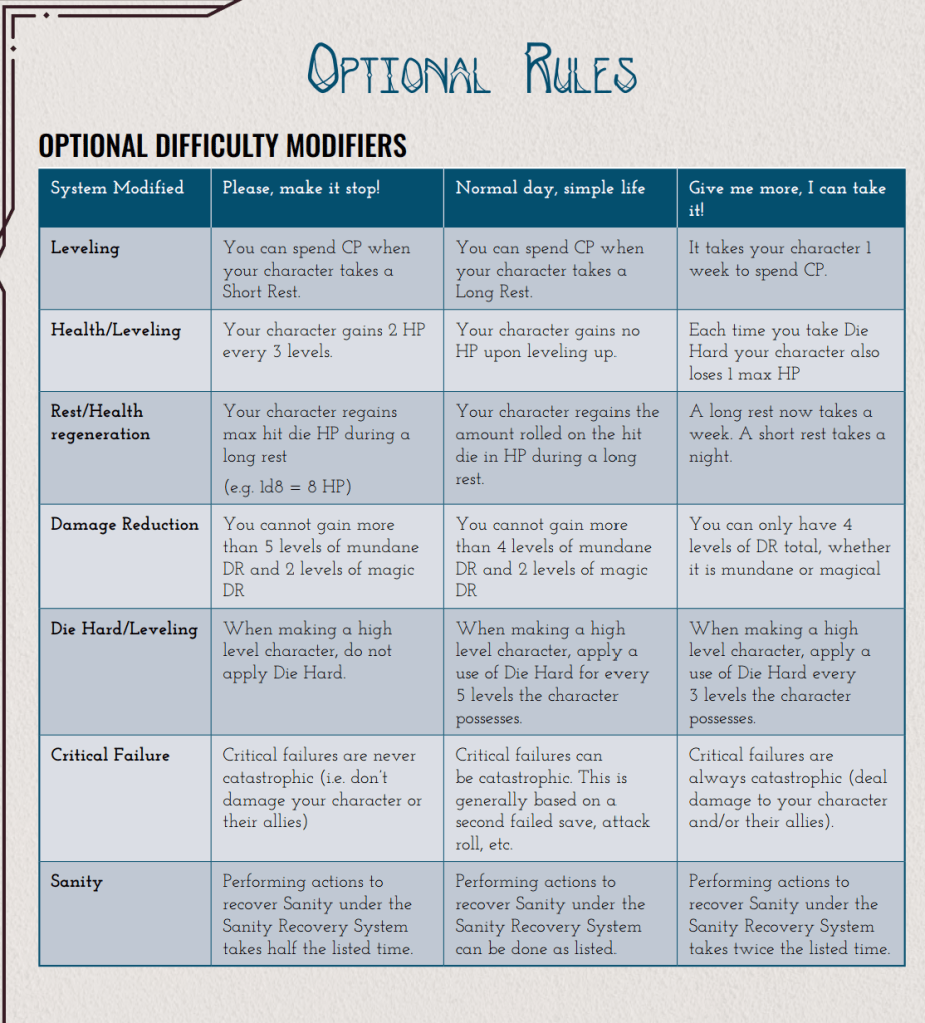
I do love that they include piles of optional rules throughout. There will be a little side bar that just says how you could do it differently, or what the changes might do. Theres even a little section of them at one point. There are a lot of dials to spin here on how you want to play.
Trying to wrap up, and conceptually the game misses the mark for me. It’s got high production values, great art, and a pretty cool concept, but the actual act of playing the game, sitting at a table and rolling dice seems like it gets in the way of the stories that Acheron wants to tell. Good mechanics help the story, and shape the narrative. These are for the most part functional, but the outcome seems to be disjointed. Its a fine first attempt at an RPG, but it falls into a lot of pitfalls for first-time designers. While worth exploring as a learning exercise, or fun with friends, a lot of the ideas should have gotten shut down when it was time to start writing a product that gets sold for money to people, they don’t personally know. People play the game you wrote rules for. We got rules for a combat sim, and thats what people will try to play. Even if the lore and vibes of the setting imply an investigation or mystery game.
The team can write good lore, and there are ideas here. But to sum it all up, they need to either write an RPG, not a reskin of 5e, or write a setting book where 5e is the right game for it. Acheron has a cool setting, and it’s held back by being forced onto the d20 chassis.
If you want to learn more about it, I’d recommend hitting up their discord. The team can certainly clear up anything I got wrong and might have some suggestions or clarifications for your table.
 The TTRPG Factory
One thought on “Acheron: TTRPG Review”