
Back on its initial release, Adder Stone Games sent us an early review copy of their game Legends of Avallen, and now, coming full circle, we have their first major campaign supplement. An adventure module set in the world of Avallen, and currently up for Pre-Release. This was a full-fledged campaign guide for players offering months or years of content, and they really went all out. Not only was it a campaign setting, but it came with an art book, map folio, and a complete 5e conversion so you can run the adventure using either system.
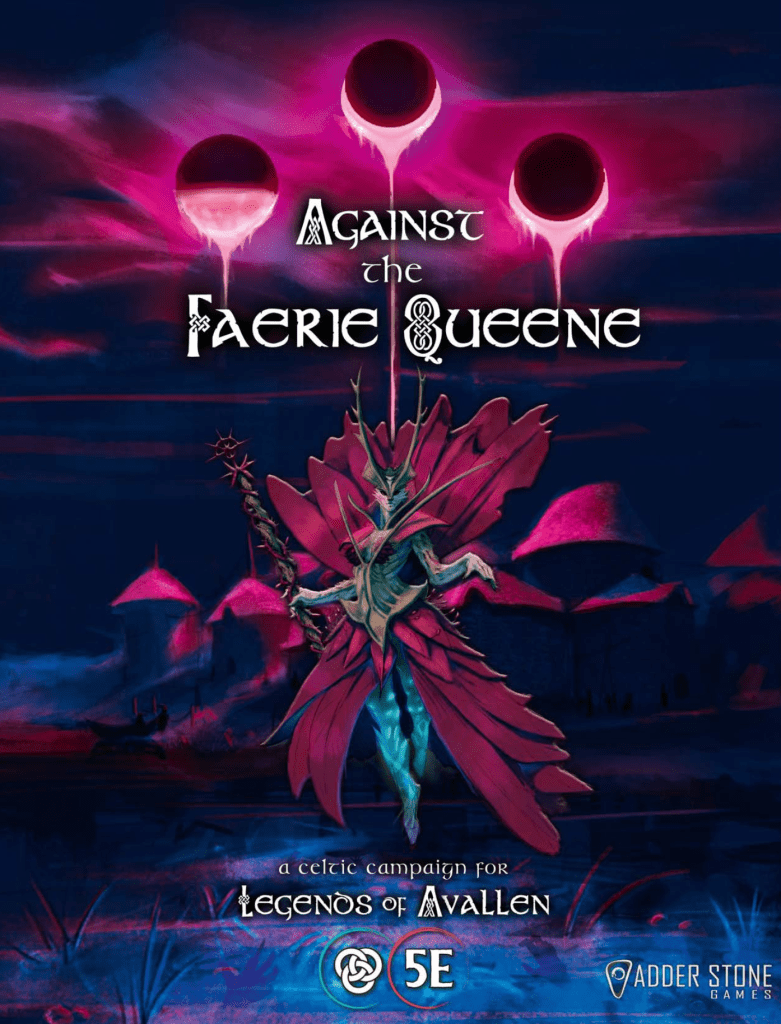
For the unitiated, Avallen is a fantasy RPG set in Celtic and Roman Britain with a heavy focus on The Fae and Celtic mythology. Avallen uses its unique playing card based system to build a story focused on prophesy and lore, with 5e conversions alongside it. This means you can run either system with the same book, and if you felt ambitious, could even pick the system resolution for the elements you want to resolve. This method is increadibly space conscious, and you can really read through the book without caring which game you’re going to run while you prep it. This is a huge boon for DMs who run multiple groups, and want to save a lot of their time.
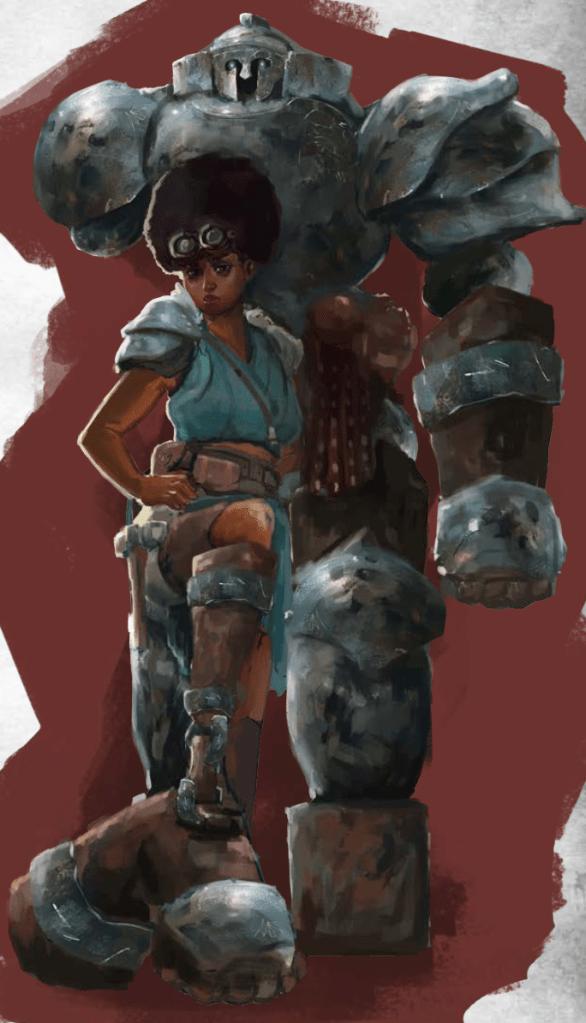
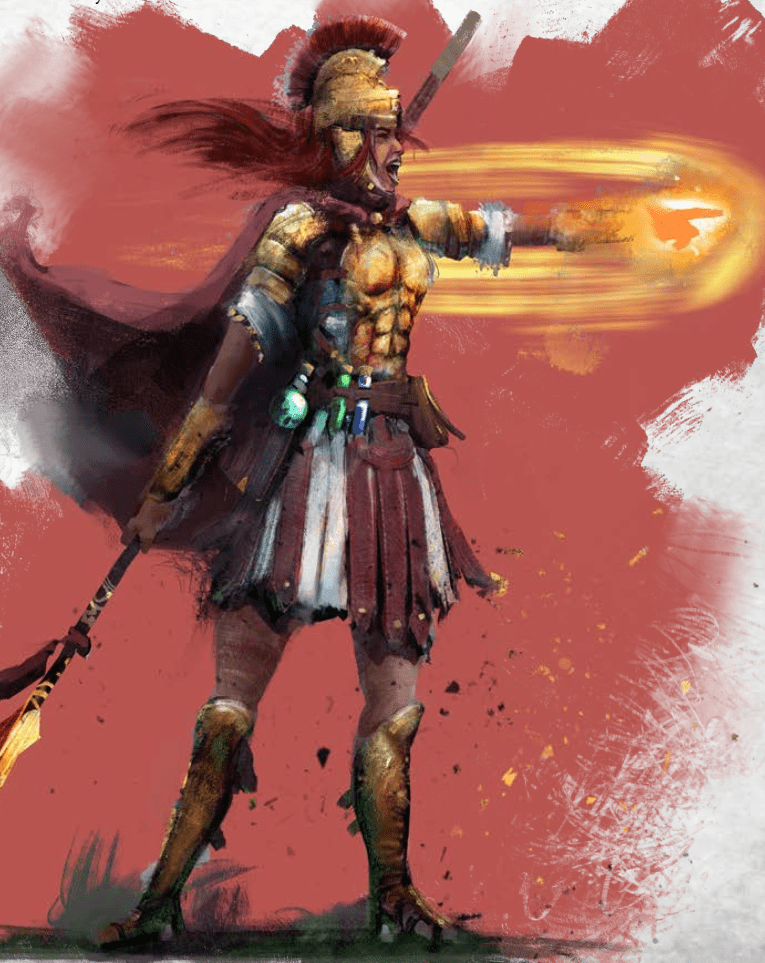
This book adds 5 new legendary paths to Avallen, and provides 5e conversions for all 15 paths in general. We get an Automaficer, an artisan who builds an automaton companion, the Enwyr, or one who studies True Names, The Faceless, a shape changing fey type, The Paragon, a great leader and pinnacle of virtue, and The Philosopher, who gets a variety of powers designed to learn about the world. The 5e versions could easily be used in other settings, and are a solid add, especially considering Avallen is probably not most DMs only RPG. It gives a nice option to trot out to your players during the weekly 5e game, and let it float with a “Well we could just play Avallen instead if you want…” backdoor into playing something that isn’t D&D a lot of groups need.
The campaign arc itself is built around the concept of a Faerie Queen who has chosen this moment to ascend, driving out the other gods and installing herself as the sole ruler of Avallen. Broad spoilers in this paragraph. The campaign takes part in 5 distinct named arcs, each focused on a different pillar of gameplay. In The Hunt, the players are on the trail of a demonic boar to save a wedding, focusing on exploring the world and learing about Avallen. In The Heist, well the players need to go on a heist. They must infiltrate a guarded compound and steal an artifact with a suggested path of stealth or cunning as opposed to violence. The Horror begins with the players solving a dark mystery in a haunted coastal town. The Games have the players compete in tests of skill while balancing tribal politics. The Cairn is the finalle, and has the players descend into a dungeon to deal with puzzles, and monsters to stop the rise of the queen. The Hunt should always be first, and The Cairn should be last, but the other three can be done at player discretion, again leading back to that concept of re-usability. The DM can run the adventure for multiple groups, and still be suprised at how it plays out differently each time.
Generally, the five phases work, and serve to highlight the variety of adventures one could tell in the world of Avallen, while also mixing things up often enough in actual play so the players never really get bored and say “Oh look these goblins have red armor as opposed to blue” as they enter the 11th dungeons of the campaign.
Overall, my personal favorite chapter is The Horror. Its got the sweet art motif of the three mooons throughout, and all the art highlights the color pallet of the region with folks wearing pink, teal, purple, and living in near darkness. Spoilers resume. It focuses on the players traveling through a cursed town, before getting trapped in a looping timeline, hanging out at the bottom of the sea, and finally dealing with an abomination made from unhappy ghosts attacking the town. Underwater settlements are the sort of things more games need, and looping timelines are my jam. I’d argue the one I put into my last campaign was probably the highlight. They really give the players time to learn and understand the environment, and clue them in that paying attention and note taking are critical. You can then lay out important information you really really need them to know (and remember) for the rest of the campaign, and help ensure it actually sticks.
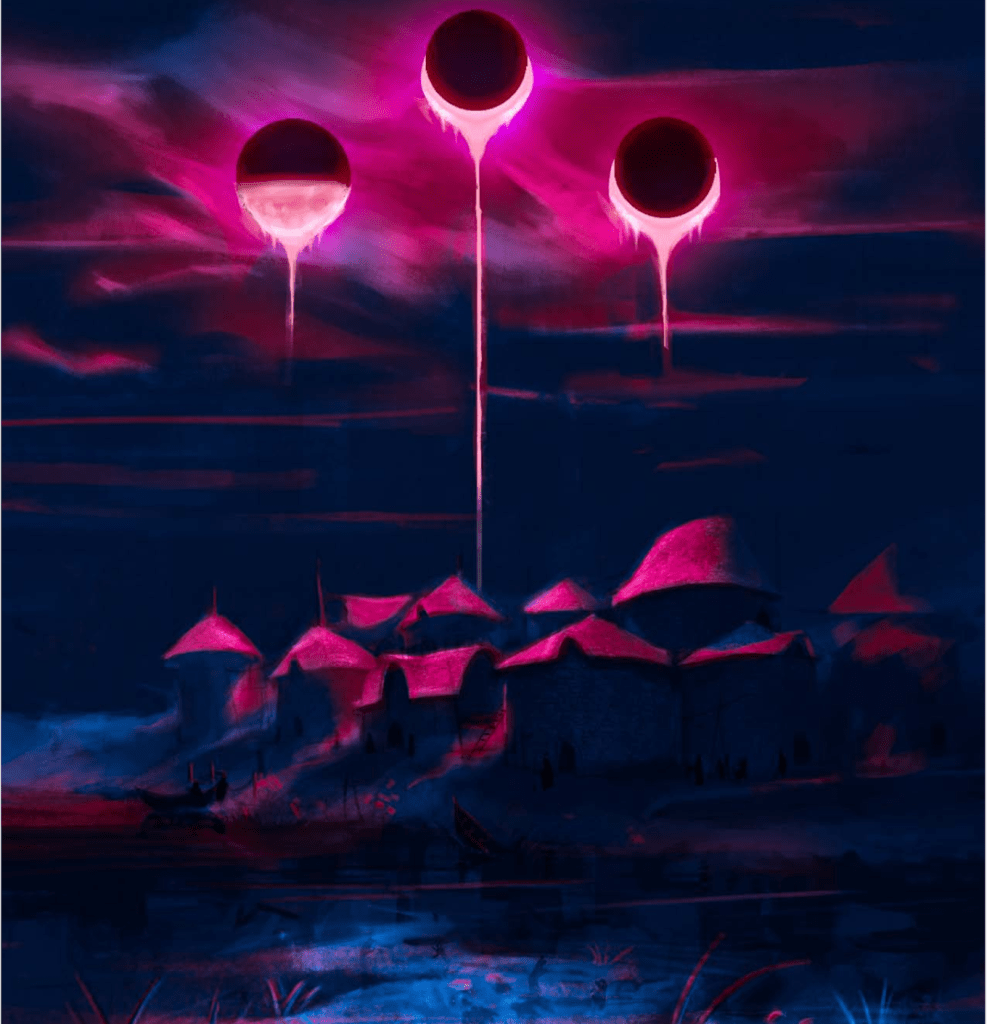
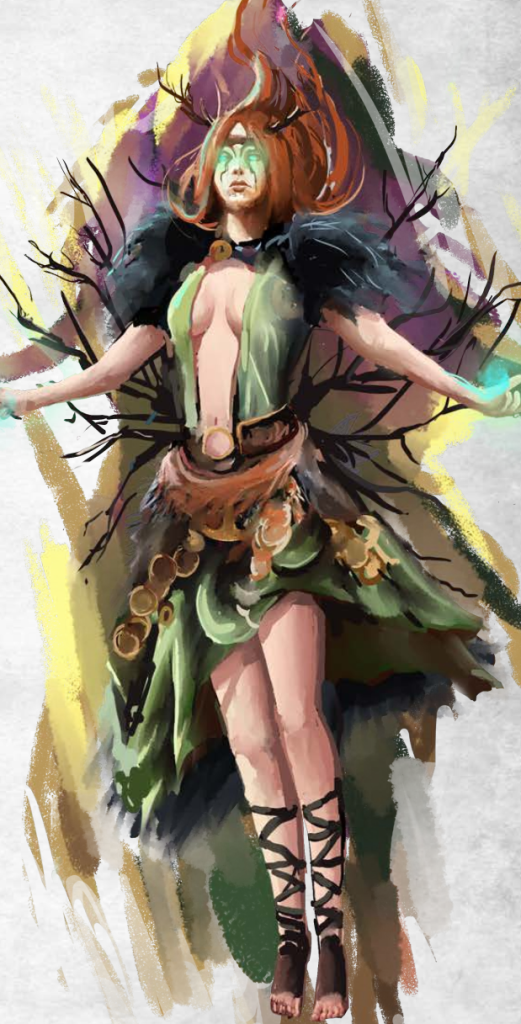
The Art in the Faerie Queene is great. Most pages are covered in awesome style, I’m very into, and we get enough to tell the story visually. In fact, there is so much of it, they put out an art book, with better versions of the art, and explanations for their design choices, and why. This is really cool, and as a DM you can ensure you’re roleplaying the NPCs with the full intent of the character and their influences. Not just the in world lore and descriptions of their personality, but things like finding out that a character was inspired by Zuko from Avatar. Knowing that, I’ll just roleplay Zuko and use him as my guiding light for how he acts in a scene.

Avallen is not designed as a wargame, and the focus is on storytelling. We get some well-illustrated maps, and the map folio I recieved had some gridded maps for combats, but its clear they are the afterthought. The maps are great, but the game isn’t particularly combat focused, and the number of mapped encounters will be a bit of a surprise for 5e fans. I say this as the guy who released a 5e book where the biggest criticism was my refusal to provide maps.

Against the Faerie Queene is the sort of book you get when you want a deep storytelling experience, focused on exploring a world filled with magic and the unknown. Players are constantly discovering more about the world around them, and players and DMs who love a good roleplay session where dice only get a couple of times will love it. As will anyone who loves a good Celtic inspired Fae setting with faeries that maybe aren’t quite all pixie dust and rainbows. US based Pre-orders and International pre-orders are live now.
 The TTRPG Factory